
Why Colored Stones Are Hot at Auction—and Diamonds Are Not

Christie’s luxury sales topped $1 billion in 2025, and jewelry was a big part of them. The company’s June jewelry sale in New York achieved $87.7 million, making it the largest various-owner jewelry auction ever held in the United States.
Max Fawcett, who became Christie’s global head of jewelry on Jan. 1 of this year, spoke with JCK about the auction market: the colored stone revival, why there may be too many big diamonds now, the “mind-boggling” K-shaped economy, how he misses the old days of auctions, and more.
Colored stones and natural pearls seem to be doing well. Is that at the expense of diamonds?
What’s so interesting is we have clients who have been diamond clients for Christie’s for the last 15, 20 years who are now colored stone clients. We have traditional clients from Israel that are bread-and=butter diamond dealers who have moved away from diamonds because it’s simply too difficult to make the margins and the prices have decreased so drastically. So colored stones is now where they’re investing their money.
That has led to a bit of a follow-the-herd mentality. People see where prices are going up and gravitate towards that area of the market. But top-quality colored stones are genuinely extremely rare, and they are relatively inexpensive compared to colored diamonds. And human psychology, I believe, will never change. Which is why I believe in the jewelry business long-term. People want what other people can’t have, and that is going to be true forever.
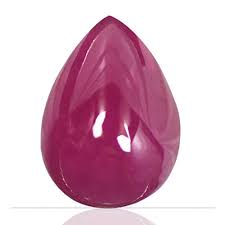
Rarity speaks volumes, and colored stones have kind of caught fire over the last five years. And it’s spread. Traditionally, we sold sapphires, rubies, and emeralds. Now paraiba tourmalines, for example, are making record prices. Spinels are ever increasingly more desirable. Ceylon sapphire is also at all-time high. So it’s not just concentrated in those one or two types of stone, but it’s also spread to other semiprecious stones.
Is there a certain novelty about colored stones?
They’re beautiful, first and foremost. When you think about what’s in fashion right now, there’s been a real renaissance of jewelry from the ’70s, ’80s, even the ’50s—retro jewelry, yellow gold, Bulgari, Van Cleef. It’s that big, bold wearable jewelry, which often has more colored stones than big diamonds.
So the demand is there, and the rarity is there, and obviously you put those two together and prices only go up.
Also, can I speak a bit about natural pearls? They are the rarest of all stones that we’re talking about.
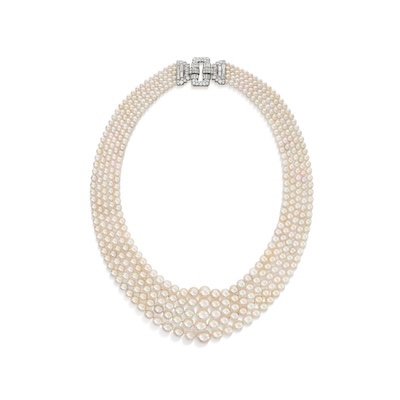
Natural pearls, unfortunately, had a stigma of being very old-fashioned I think that is changing. We’re seeing more natural pearls being worn on the red carpet. We’re seeing men wearing pearls in fashion. And rather than being solely in the Far East and the Middle East and India, we’re seeing more demand in Europe and America for natural pearls. I am very bullish on natural pearls, because first of all, they’re absolutely gorgeous, and second of all, they are so rare that I think they will become appreciated in the way that they should be.
Back to diamonds, it used to be rare for truly big diamonds to appear at auction. Now that miners have improved their technology, it seems like there’s more of them. Could that also be hurting prices?
That’s definitely one of the factors. Fifteen, 20 years ago if we had a 50 ct. D flawless at auction, people were shocked, and it was a one-off and it was rare.
With the new 3D mapping technology that [the miners] have, they can see the rough diamonds in the ground before mining them, so they can dig around the rough and not crush [big stones]. And every year larger pieces are mined, which has definitely detracted from the value. To be able to say to a client, “This is the rarest thing you’ll ever see,” and then for another bigger [diamond] to appear next year, it’s never great.
Another key factor with white diamonds is there’s simply too many of them. There aren’t many buyers who want to buy 30, 50, 80 ct. white diamonds. They’re not necessarily that practical to wear. They’ve been a very poor investment, given they’re worth so much less than they were worth in 2010, 2011.
On top of that, look at the regions where the majority of those stones were being sold. Russia was a huge driver [of demand for] large D flawless quality diamonds. They are no longer in the market, with everything going on. China was a huge driver of these stones. Capital controls in China have made it incredibly difficult for people to spend money in the way that they would perhaps like to. KYC [“know your customer” protocols] has become a bigger part of the business and has made it less easy for people to invest money that they want to.…
Having said that, I do see some rays of positivity now. When the price of rough becomes more expensive than polished, it doesn’t make sense for the smaller producers and players to stay in the market. That should decrease the supply of diamonds available and hopefully provide some upward pressure on prices. We have already seen some prices go up over the course of this year, which is great, but there needs to be more.
We are hearing a lot about the “K-shaped” economic recovery—that the rich are getting richer, and the poor are getting poorer. Obviously, Christie’s caters to the high end. Are you seeing that?
The K-shaped recovery is unfortunate, very real, and it doesn’t just apply to America. I was in India at the beginning of this year and people there were talking about this K-shaped recovery. The exponential growth in wealth of the rich is unlike anything we’ve ever seen before in history. It’s mind-boggling numbers.
As you said, Christie’s is positioned on the top of the K. So, we certainly do see clients collecting more, and collecting in a very passionate way. What we’d love to see more than anything is a broadening of our client base and covering more areas.
Christie’s has talked about attracting Gen Z buyers and younger buyers. How are they different from older clients?
The auction world has changed so much over the last 25 years. Auction houses used to have items from private clients sold to dealers. When you look at the catalog from 30, 40 years ago, it was more of a dealer thing.
Now with digital marketing and press campaigns, we’re really touching so many different parts of the world, in a way that connects with that younger generation of buyer. Christie’s is much more visible today than it ever has been, thanks to these digital tools.… We’re also seeing a lot more female buyers buying from us.
Does it help that the auctions are now held online?
I think it works both ways. For me, I’m very sad that we don’t have the same kind of in-room atmosphere that we used to have. That was one of the great excitements, especially as an auctioneer: having a packed sale room full of clients, frenzied bidding, people shouting out numbers. As an auctioneer, that is kind of a dream. That still happens, occasionally, for crazy marquee sales that we do and single-owner sales. We still have some of that.
On the other hand, being able to have so much of your bidding online and on the phone has allowed us to sell to a lot more clients every auction. Obviously, that’s great for Christie’s from a client engagement standpoint. The touchpoints we have around the world have just exploded, and it’s increased the number of clients tremendously.

What do you see coming up in the next year?
Private sales are a key part of our business—connecting a buyer and seller outside of the auction platform, sometimes for confidentiality, sometimes for speed. Some years, the biggest transactions are actually done through our private sale platform. That’s something we will continue to grow, and it has so much opportunity to expand.…
I think we’re up for a great 15, 20 years coming up. At the beginning of the 20th century until 1950 or so, nearly all of the great jewelry collections were built in Europe. Now we’re coming to a point, 100 years later, where many of those collections are going up for sale, either due to succession or that people just don’t want the jewelry anymore, whereas in other parts of the world—in the Middle East, in India, in China—we have many clients who are looking to buy jewelry.
I think the next five, 10 years will be extremely exciting when it comes to auctions. We are going to see a real flurry of great collections come to sale. And what’s so amazing about the jewelry business is how much great stuff there is out there which no one’s seen for such a long period of time.
Every year we put together another few hundred million in sales, and it gets absorbed and you think: Where are we going to find it next year? Then another great collection comes up. There is still so much top jewelry out there which has not seen the light of day in the last 50, 80, 100 years. And we’re going to start seeing a lot more.
(Photos courtesy of Christie’s)
Recent Comments